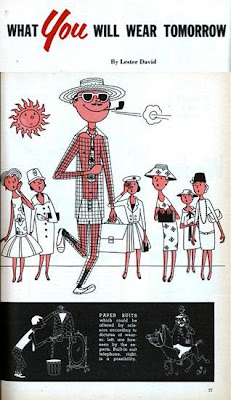
WHAT YOU WILL WEAR TOMORROW - october 1958
By Lester David
"MEN’S fashions, long noted for their sepulchral hues and funeral cut, are currently erupting in a major revolution of styles, colors and surprises. Gone are the days of the petrified collar and suits of “cast iron tweed.” New fabrics, new fashions and new fads are the order of the day. Where will it all end?"
still a big question, huh?"We asked clothing and industrial designers, textile manufacturers and other experts to peer into their crystal balls and tell us what lies ahead in the field of male fashion. Here are some of their amazing answers: For the immediate future the sunburst of color adopted a few short years ago will get even wilder. According to Baker Case of Hatton Case, a leading men’s wear establishment in New York, waistcoats, Bermuda shorts, sport shirts, cabana outfits and swimming trunks will blaze even louder as the seasons go on.
In Hollywood, Sy Devore, who fashions suits for filmdom’s top stars, has already removed breast pockets from men’s suits because he claims they are totally unnecessary. He’s even eliminated the lapel buttonhole. “Absolutely unneeded,” he asserts.
What about the distant future? The wonders will continue, experts claim, and before too many years have elapsed episodes like this one may be commonplace: A fellow is out to dinner with his best girl. While staring into her eyes, his hand trembles and a blob of gravy drops on his pants. He just lets it dry, then reaches into a pocket for an eraser and rubs out the spot!"
We wish !"That evening, the same chap surveys himself in a mirror and decides he’d look better in narrower lapels. No fancy tailoring bills for him. He merely takes out a pair of scissors and snips his lapels to the desired width."
The little fairy came and Issey Miyaké was here ("A-POC, a piece of clothe" project)“There will be no buttons to come loose or to lose on these clothes of the future. A small magnet fastened to each side of the jacket will keep the front closed.”
Oh Jenny this makes you happy..."These experimental paper clothes can be draped, printed, silk screened and cut and sewn like any other fabric. They can be made to specifications, varying in strength, appearance and texture, and can also be rendered water and flame resistant.
How else can male garb be improved for greater comfort and more efficiency? Officials at Burdick-Rowland Associates, a noted firm of industrial designers, offer these future possibilities.
They suggest a suit made entirely of netting (with the vital areas covered, of course). No part of the netting would touch the wearer. The material would be suspended about a half inch from the body by a simple wire arrangement or small suction cups. What could be cooler for long suffering males in summer?"
see image above. Just awesome"Another suggestion is clothes with air vents built into them for maximum hot weather comfort. These vents, or air scoops, could be attractively designed and made a part of the suit’s pattern.
A small built-in air-conditioner and de-humidifier operating on transistors would be useful. The jacket housing the device would have to be lightweight and airtight with the neck and sleeves closed.
Communications could also be simplified in the clothing of the future. Ben Fromkin, a Burdick-Rowland designer says, “Why not a two-way telephone built right into the suit, powered by solar light?”"
hm hmmmm. Fascinating Source : Mechanix Illustrated, october 1958 via
Modern Mechanix Blog


 Labels:
fair trade,
fashion,
organic,
people tree,
sample sale,
social justice,
sustainable
Labels:
fair trade,
fashion,
organic,
people tree,
sample sale,
social justice,
sustainable
 From the Kunstmuseum in Wolfsburg, Germany (http://www.kunstmuseum-wolfsburg.de/):
 Viktor & Rolf ; Louise Bourgeois
 Interesting! But how can it be used in textiles??
 Please leave some suggestions, because for now, all I can think of is a light-up meat dress (concept: Katy Parry's dress marries Lady Gaga's dress).
 Sarah Burton delivered an impressive collection for the Alexander McQueen SS11 runway show in Paris last week.
 The textiles were elabourate constructions reminiscent of armour, seemingly crafted by forest dwellers sensitive to their natural surroundings.
 Colours referred to the palete of an autumnal woods - cream coloured mushroom caps, orange leaves, rust-coloured lichen, black beetles, yellow foliage and white birds.
 The models wore pretty braids, long enough to twirls around their arms and trailing into tapers at the ends. It looked like there were ribbons wrapped in their hair.
 It was all very pretty. A return to the gentle side of Alexander McQueen, heavy on the handcraft and nature, and light on the aggression.
 Still, the garments spoke of strength. The intensely woven and modern victorian tailored pieces were like exoskeletons of tough little insects, with a taste for modern Victorian tailoring.
 view the entire collection's runway video: http://www.alexandermcqueen.com/int/en/corporate/archive2011_ssfilm_womens.aspx
 Wearable electronics are finally going mainstream. CuteCircuit, a fashion label that is headed in part by an electrical engineer, has been designing electronic textiles for years. Their work finally came into the spotlight when Katy Perry wore a custom-made LED dress at the infamous Met Costume Institute Gala in New York. Thanks to the combined effect of Perry's celebrity status and the media frenzy that follows the Met Ball, the dress was all over the press.
 It generated so much interest that other pop stars of the Katy Perry-type took notice. Rihanna wore a Moritz Waldemeyer-built LED dress onstage the following week. A month later, Safura wore one made by (again) CuteCircuit.
 In fact, CuteCircuit, and powered garments in general, have been in the press for a long time. It just took the right kind of press to get them into the mainstream. WIRED and Computerworld took notice of them years ago, but the Katy Perry collaboration caught the attention of Grazia, Hello!, OK, The Daily Mail, Women's Wear Daily, etc.



